Letgro is a digital marketing agency that specializes in AI visibility, helping businesses in the GTA and across Ontario show up when people ask AI platforms for a recommendation.
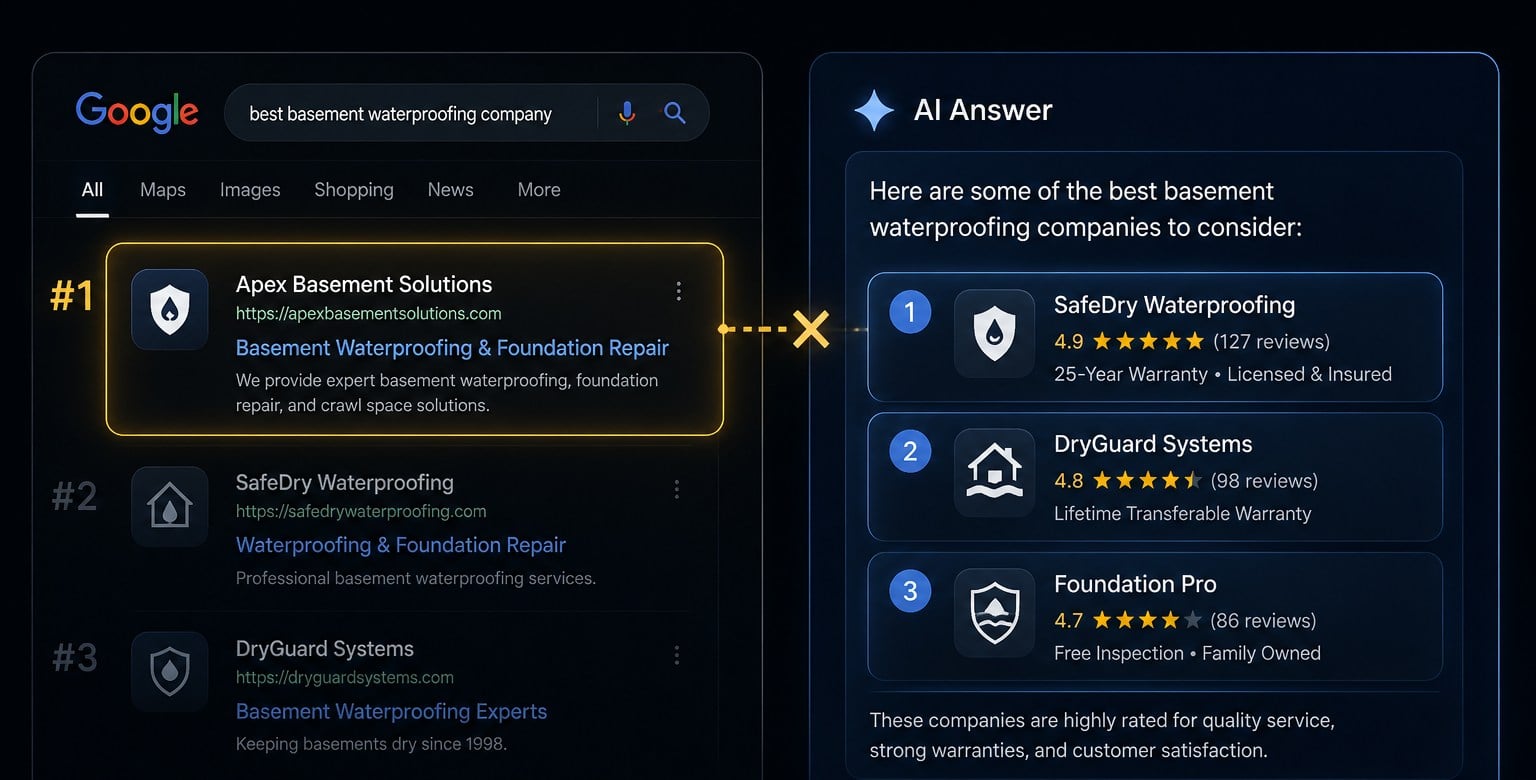
Your business can rank on page one of Google and an AI assistant can still leave your name out when a customer asks who to call. That's not a small gap anymore. It's most of the answer.
The short version:
- Only 38% of the pages AI Overviews cite also rank in Google's top 10, down from about 76% a year earlier (Ahrefs, 2 March 2026, 4 million AI Overview URLs checked).
- A separate tracker found it even lower: 16.7%, as of 18 September 2025 (BrightEdge). The exact numbers don't agree. The direction does: most of what AI cites was never on page one.
- Letgro tested this directly in the GTA on 7 August 2026. A page titled "#1 Basement Waterproofing Service Scarborough" ranked, and was never named. A company with no ranking at all got named off one detailed review.
- What got companies named wasn't their rank. It was a licence number, an insurance policy, a warranty term, or a review that said exactly what was done.
Does ranking high on Google get you cited by AI?
Not reliably, and less than it used to. Ahrefs checked 4 million AI Overview URLs on 2 March 2026 and found only 38% of what gets cited also ranks in Google's top 10, down from roughly 76% in July 2025. BrightEdge, tracking the same question, put the overlap even lower at 16.7% as of 18 September 2025.
A ranking used to be a decent bet that an AI would repeat you. That bet has gotten a lot worse in about a year, and it keeps getting worse.
Why would Google's own AI skip a page that ranks on Google?
Because ranking and getting picked for an answer are two different jobs now, even inside Google's own tools. A ranking algorithm sorts pages by relevance to a search term. An AI answer has to pick a short, exact fact or sentence, and it favors whichever page states that fact most plainly, whether or not that page sits at the top of the results.
Search rank still counts. Cyrus Shepard's Zyppy Signal study (7 May 2026, 54 experiments across 23 factors) still puts it second overall. It's just no longer enough by itself, and the gap between "ranks well" and "gets cited" is the size of most of the market now.
What actually gets a business named instead of just ranking?
Facts a machine can check, not marketing. Letgro's own test in the GTA makes this concrete rather than theoretical.
On 7 August 2026, one AI assistant was asked who to call for a wet basement in Mississauga, Etobicoke, and Scarborough. Thirteen companies got named. Only one, RCC Waterproofing, was named in all three cities. In Scarborough, a company whose own page title reads "#1 Basement Waterproofing Service Scarborough" ranked and was never named once. Meanwhile ACE Waterproofing, which didn't turn up in the search results at all, got named on the strength of one HomeStars review that described exactly what the company fixed.
| Company | Named in AI's answer | What got cited |
|---|---|---|
| RCC Waterproofing | All 3 cities | Not stated in the answer itself |
| Direct Waterproofing | 2 of 3 cities | City licence, WSIB coverage, 25+ years, 5-star rating, 25-year warranty |
| Aquatech Waterproofing | 1 of 3 cities | A HomeStars "Best of" award |
| Aquamaster | 1 of 3 cities | A BBB rating |
| ACE Waterproofing | 1 of 3 cities, despite not ranking | One detailed HomeStars review |
This is a one-assistant pilot in three cities, not a finished study, and it's honest about that. But the pattern in the table is the same pattern the bigger numbers show: what gets repeated is what's written down somewhere plain, not what ranks.
Do you need to rebuild your site for AI, with chunking or an llms.txt file?
No, and this is worth saying plainly because most of the AEO market sells the opposite. Google's own guide to AI search, published 15 May 2026, says there's no requirement to break your content into small pieces, no need to rewrite for AI specifically, and structured data "helps but isn't mandatory."
Zyppy's factor study backs this up from the other direction: llms.txt scored 2.0 out of 10, dead last of 23 factors measured. URL accessibility, the plainest and least exciting factor there is, scored highest at 9.5. The fix here isn't a technical trick. It's making the same facts that got the waterproofing companies named, licence numbers, warranty terms, specific reviews, easy to find in ordinary text.
Do mentions matter more than backlinks for this?
Yes, by a wide margin. Ahrefs studied 75,000 brands and found branded mentions correlate with AI visibility at 0.664. Backlinks scored 0.218, a third as strong. Muck Rack, looking at more than a million AI citations, found 82% came from earned media and 94% weren't paid for at all.
That lines up with what the GTA test found too. ACE Waterproofing didn't earn a link. It earned one specific, detailed mention, and that was enough.
What should you do about this?
Three things, in the order that pays off fastest.
- Ask an AI who does what you do in your city. Four minutes, no tools needed. If you're not in the answer, you now know where you actually stand.
- Put your licence number, insurance, and warranty terms in plain text on your site. Not in a PDF. That's what showed up as a cited reason every time in the test above.
- Ask happy customers for reviews that say what you did, not just a star count. A star rating gives an AI nothing to quote. A sentence about the actual job gives it something to repeat.
What we don't know yet: whether this pattern holds the same way on ChatGPT, Perplexity, and Gemini specifically, since this test used one assistant. The full version, 40 fixed prompts across four platforms, run monthly, is still coming. Until then, treat this as a strong first read, not a settled answer.
If you want the deeper version of this check run on your own business, see what Letgro's AEO service covers.